What does it take to lead effectively when the challenges are unprecedented and there is no clear path forward?
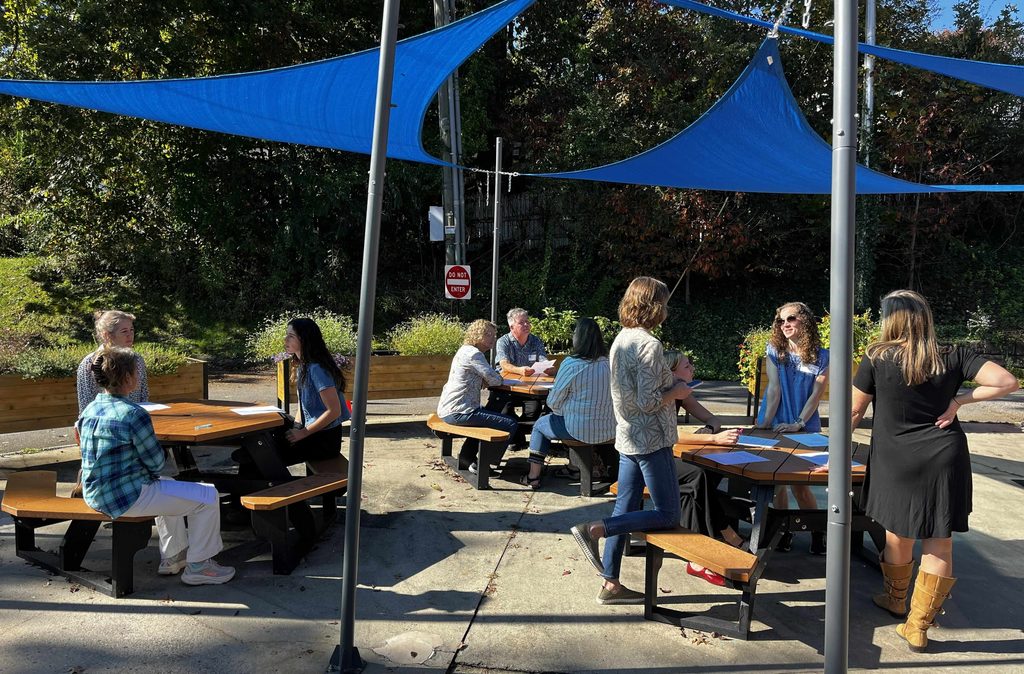
That question is at the heart of The In-Between (TIB), a new Adaptive Leadership Community of Practice that recently launched in Western North Carolina. Hurricane Helene showed how deeply connected communities are, and how much recovery depends on collaboration across sectors. TIB was designed with those lessons in mind. In partnership with Western Carolina University’s Local Government Training Program, the UNC School of Government, the North Carolina Council of Churches, and Resources for Resilience, it brings together leaders from local government, nonprofits, faith communities, and grassroots organizations.
For eight months, cohort members will come together twice a month to strengthen relationships, practice adaptive leadership skills, and expand the collective capacity to continue rebuilding from Helene while preparing for future challenges. Participants are helping shape the program itself, co-creating its direction and practicing new ways of learning together.
Adaptive Leadership Beyond the Cohort
You don’t have to be in Western North Carolina, or in the cohort, to practice the principles TIB is built on. The program also invites a broader question: What is adaptive leadership, and how can we practice it in our everyday lives?
Developed by Harvard leadership scholars Ronald Heifetz and colleagues, adaptive leadership distinguishes between technical problems and adaptive challenges (Heifetz, Grashow, & Linsky, 2009):
- Technical problems have known solutions and can be solved with existing expertise and established processes. Examples of technical problems include repairing potholes, conducting routine water-quality testing, and preparing a routine budget report.
- Adaptive challenges are complex, hard to identify, and have no known solutions. For example, addressing housing affordability, workforce shortages, and rebuilding public trust are adaptive challenges. Adaptive challenges require people to try new strategies, change their behaviors, and collaborate to develop creative solutions.
Adaptive leadership is about mobilizing people to tackle adaptive challenges together.
Practicing Adaptive Leadership
Adaptive leadership begins with small shifts in how we approach challenges. Here are four practices to try:
- Step back and see the bigger picture. Heifetz and colleagues call this getting “on the balcony,” meaning temporarily stepping back from daily tasks to observe the whole system, spot patterns and group dynamics, and see how your behavior affects others. Instead of immediately reacting or trying to fix a problem, ask yourself, “What is really doing on here beneath the surface?”
- Get curious about different perspectives. Adaptive challenges often involve multiple stakeholders with different perspectives, priorities, and ideas about what success looks like. Seek out people affected by the issue, especially those whose voices are often missing. Ask what they see that you might be overlooking.
- Experiment and learn. Rather than waiting for certainty, choose a small step or change, test it, observe what happens, and adjust. Share what you learn. This approach makes progress possible even when a full solution is not yet clear.
- Share the work of leadership. Rather than trying to solve every problem yourself, help others take responsibility, build connections, and develop the capacity to find solutions together. Remember to attend to your own resilience. Leading through uncertainty means staying engaged even when progress is slow or uncomfortable.
Adaptive leadership is about building resilience, relationships, and shared capacity to move forward in the face of complex challenges. It happens in the in-between: between sectors, between uncertainty and solutions, and between the way things are and what our communities might create together.
Choose one practice to try this week and notice what shifts.
To learn more adaptive leadership, read Leadership on the Line (Heifetz & Linsky, 2017) and The Practice of Adaptive Leadership: Tools and Tactics for Changing Your Organization and the World (Heifetz, Linsky, & Grashow, 2009).
The In-Between invites other adaptive leaders to join their monthly socials. Email adaptinginbetween@gmail.com to get on the invitation list.
