
This is Part 1 of a three-part series on organizational culture.
Whether you are a city manager dealing with a budget shortfall, a parks and recreation director managing a staffing shortage, or a public works director staring down an environmental compliance deadline, leadership in public service is about dealing with what the late organizational scholar Peter Vaill described as “permanent whitewater” conditions. Leading in public service is not like paddling a calm lake, occasionally disrupted by a brief storm. No, the turbulence is ongoing. Leaders are constantly navigating rapids, dodging rocks, and reacting to shifting crosscurrents.
This permanent whitewater keeps leaders’ time, energy, and attention on what is urgent, what is pressing, what is in their faces. Consequently, the important but less obviously urgent tasks of leadership get pushed to the sidelines. We tell ourselves that we will focus on organizational health and team dynamics when things calm down a little. But the river never stops churning. And at a moment when public agencies are facing historic workforce pressures — retirements, recruitment challenges, post-pandemic morale shifts, and increasingly politicized work environments — the cost of neglecting organizational culture has never been higher.
Stephen Covey’s classic book, The Seven Habits of Highly Effective People, offers a useful frame for understanding why. He calls it the “P/PC Balance.” “P” stands for Production, the value your organization creates in terms of service delivery and public problem solving. “PC” stands for Production Capability, the underlying capacity that makes production possible. Covey's warning was simple: focus entirely on production (P) while neglecting the production capability (PC), and eventually production will drop off.
In organizations, a primary component of production capability is organizational culture. Culture problems usually don’t announce themselves dramatically. They tend to simmer and manifest as low morale, turnover, burnout, departmental silos, and defensive postures where staff hide mistakes rather than solving them. Public service is often high-stakes, highly visible, and emotionally demanding, which makes organizational culture especially important. In this context, culture shapes not only how teams function internally, but also how effectively they serve and build trust with the public.
Many leaders, especially those from technical disciplines like engineering, finance, or planning, were never trained to think of culture as part of their job. That’s understandable. But here’s the thing: whether you tend to it or not, culture is always at work. The only question is whether it is working for you or against you.
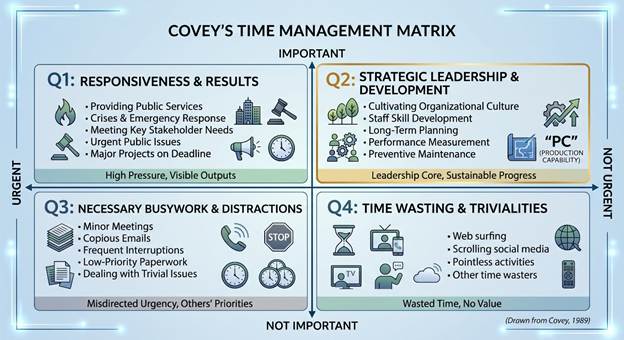
This dynamic becomes even clearer when we map leadership tasks onto Covey’s Time Management Matrix. The matrix sorts work by urgency and importance. Quadrant I — urgent and important — is where we must be responsive and where we produce results. We cannot ignore it. But leaders who live entirely in Q1 tend to burn out, and their organizations pay the price. The real work of leadership is in Quadrant II: important, but not urgent. No alarm goes off for Q2 work. No one calls at 6 a.m. about it. That’s why it tends to get crowded out. Attending to culture is perhaps the ultimate Quadrant II leadership activity.
When folks talk about culture, they sometimes reach for mechanical metaphors: culture as the “invisible engine” or the “operating system” of an organization. But mechanical metaphors fall short here because public service organizations are not machines. They are complex human systems.

A more fitting metaphor: organizational culture is the soil in which your team grows. Think about the last time you joined a new team, or watched a new hire find their footing. Within weeks or even days they had absorbed “how things are done here,” often without anyone spelling it out explicitly. That invisible, guiding force is culture. As organizational psychologist Edgar Schein defines it, culture is “a pattern of shared basic assumptions that a group learns as it solves its problems of external adaptation and internal integration.” It is more than the “vibe” of a place. It is the complex fabric of shared values, beliefs, and unspoken rules that govern how people behave, make decisions, and interact. And its effects reach well beyond the walls of your office. Culture problems show up externally as well, in service quality, in community responsiveness, in whether residents trust the institutions meant to serve them.
Cultivating that soil is Quadrant II work. Fertilizing, aerating, and tending to team culture is never going to scream for your attention on a Tuesday morning like a water main break will. But investing in the soil is the only way to ensure your team can produce a sustainable harvest over the long haul.
The soil doesn’t announce when it’s depleted or otherwise unhealthy. Neither does organizational culture. By the time the warning signs are obvious, the damage has been accumulating for years. The goal of this series is to help you learn to read the soil and tend it before the effects show up in your harvest.
We’ve discussed why leaders need to “get” culture. In the next post, we’ll dig beneath the surface using Edgar Schein’s three-level model of organizational culture, and we’ll introduce a practical culture audit you can use to assess the health of your own team culture.
Peter Vaill's concept of “permanent whitewater” appears in Managing as a Performing Art (Jossey-Bass, 1991). Stephen Covey's P/PC Balance and Time Management Matrix are from The 7 Habits of Highly Effective People (Simon & Schuster, 1989). Edgar Schein’s definition of culture is drawn from his extensive body of work, including Organizational Culture and Leadership (Wiley, 2016).
